






























PSI 2026

Iron And Alcohol Used To Efficiently Recycled PET Plastics

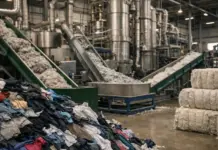
Note* - All images used are for editorial and illustrative purposes only and may not originate from the original news provider or associated company.

Subscribe

- Never miss a story with notifications

- Browse free from up to 5 devices at once

- Gain full access to our premium content

Media Packs

Expand Your Reach With Our Customized Solutions Empowering Your Campaigns To Maximize Your Reach & Drive Real Results!
– Access The Media Pack Now!
– Book a Conference Call
Leave Message for us to Get Back

Related stories

Sorting Technologies Revolutionizing Pre-Consumer and Post-Consumer Textile Recycling

Advanced sorting technologies—near-infrared spectroscopy, Raman spectroscopy, RFID tagging, digital identification systems, and AI-powered computer vision—are revolutionizing textile material classification and enabling automated processing at previously impossible scale and accuracy. These technologies simultaneously address the sorting bottleneck that has constrained recycling scaling, achieve accuracy exceeding 95-98%, process materials at industrial speeds, and provide cost reduction of 25-35% through labor elimination and processing optimization, fundamentally transforming textile recycling economics and feasibility.

The Role of AI and Automation in Advancing Textile Recycling Systems

Artificial intelligence and automation technologies are revolutionizing textile recycling by dramatically improving sorting accuracy, material separation efficiency, and overall system throughput. Machine learning algorithms, computer vision systems, near-infrared spectroscopy, and robotic automation are transforming labor-intensive manual processes into intelligent automated systems capable of identifying and processing hundreds of items per hour with accuracy exceeding 95%, enabling scalable textile recycling infrastructure that was previously economically unviable.

How Digital Fashion Trends are Reshaping Brand Identity

Digital fashion—virtual garments, metaverse clothing, AI-styled avatars, and NFT-based digital collectibles—represents unprecedented frontier in fashion expression and brand positioning. As consumers increasingly inhabit virtual spaces through gaming, social platforms, and metaverse environments, brands develop digital-native strategies reshaping traditional fashion business models while creating opportunities for virtual-only design expression unbounded by physical materiality constraints.

Using iron and alcohol, chemists have created a straightforward method for converting a popular plastic (PET) back into virgin material.

The technique is noteworthy for its selectivity, since it has the ability to recycle PET in blends with textiles and plastics.

The study conducted by the Malaysian and Japanese scientists has been published in Industrial Chemistry and Materials.

One typical polyester material that is used extensively in textiles and drink containers is polyethylene terephthalate, or PET.

While melting and reforming PET water bottles may recycle them, it can result in lower-quality plastic and necessitates carefully separating the PET from all extraneous elements.

Polyester fabrics and mixed garbage are difficult to recycle using this technique. Blends of fibers, such as polyester and cotton, are especially challenging to recycle since separate polyester and other fibers need to be unwound first.

Rather, scientists have been attempting to disassemble PET molecules. PET is a polymer, same like all other plastics, consisting of lengthy chains of monomers, or repeating units.

Depolymerization reactions that can convert PET back into reusable monomers have been studied by chemists, however the majority of existing processes call for high industrial temperatures as well as corrosive acids or bases.

Using just alcohol and an inexpensive iron-based catalyst, the novel process developed by these researchers may be carried out at temperatures below 200°C, which is low by industrial standards.

Researchers discovered that combining PET with ethanol and either iron(III) bromide (FeBr3) or ferric chloride (FeCl3) for a few days at 160–180ºC produced a nearly pure combination of the monomers needed to create PET.

Diethyl terephthalate and ethylene glycol are monomers that may be used in other materials or to produce additional PET of superior quality.

The researchers tested the ferric chloride catalyst on a waste textile composed of 65% PET and 35% cotton because it performed really well.

In 16 hours, they were able to extract the monomers from the fabric and produce pure cotton and monomers.

Additionally, they could extract PET only from textiles that include mixtures of other polymers.

The researchers note in their report that ferric chloride is an inexpensive catalyst that is already often employed in industry.

They think that if a commercially viable catalyst is present, the technology may provide the option of a clean chemical recycling process.

The group is now examining whether they can accomplish the same outcomes under more accommodating circumstances.

Latest stories

Related stories

Sorting Technologies Revolutionizing Pre-Consumer and Post-Consumer Textile Recycling

Advanced sorting technologies—near-infrared spectroscopy, Raman spectroscopy, RFID tagging, digital identification systems, and AI-powered computer vision—are revolutionizing textile material classification and enabling automated processing at previously impossible scale and accuracy. These technologies simultaneously address the sorting bottleneck that has constrained recycling scaling, achieve accuracy exceeding 95-98%, process materials at industrial speeds, and provide cost reduction of 25-35% through labor elimination and processing optimization, fundamentally transforming textile recycling economics and feasibility.

The Role of AI and Automation in Advancing Textile Recycling Systems

Artificial intelligence and automation technologies are revolutionizing textile recycling by dramatically improving sorting accuracy, material separation efficiency, and overall system throughput. Machine learning algorithms, computer vision systems, near-infrared spectroscopy, and robotic automation are transforming labor-intensive manual processes into intelligent automated systems capable of identifying and processing hundreds of items per hour with accuracy exceeding 95%, enabling scalable textile recycling infrastructure that was previously economically unviable.

How Digital Fashion Trends are Reshaping Brand Identity

Digital fashion—virtual garments, metaverse clothing, AI-styled avatars, and NFT-based digital collectibles—represents unprecedented frontier in fashion expression and brand positioning. As consumers increasingly inhabit virtual spaces through gaming, social platforms, and metaverse environments, brands develop digital-native strategies reshaping traditional fashion business models while creating opportunities for virtual-only design expression unbounded by physical materiality constraints.

Subscribe

- Never miss a story with notifications

- Gain full access to our premium content

- Browse free from up to 5 devices at once

Media Packs

Expand Your Reach With Our Customized Solutions Empowering Your Campaigns To Maximize Your Reach & Drive Real Results!

– Access The Media Pack Now!
– Book a Conference Call
Leave Message for us to Get Back

Translate »